About the language
Ladakhi (Written Tibetan: ལ་དྭགས་སི་སྐད; Wylie: la.dwags.si.skad) is a Western Tibetic language spoken in the Leh and Kargil districts of Ladakh, India. The term Ladakhi is often used as a cover label for several closely related Western Tibetic varieties spoken across the region. Following Zeisler (2018), these varieties can be broadly grouped into Shamskatic and Kenhatic Ladakhi, reflecting major morphosyntactic and phonological divisions within Ladakh.
Phonologically, many Ladakhi varieties are relatively conservative within Western Tibetic, retaining consonantal features traceable to Old or Classical Tibetan. At the same time, significant internal variation exists across the region, shaped by geography, contact, and historical mobility. For a broader overview of Western Tibetic classification, see the research overview.
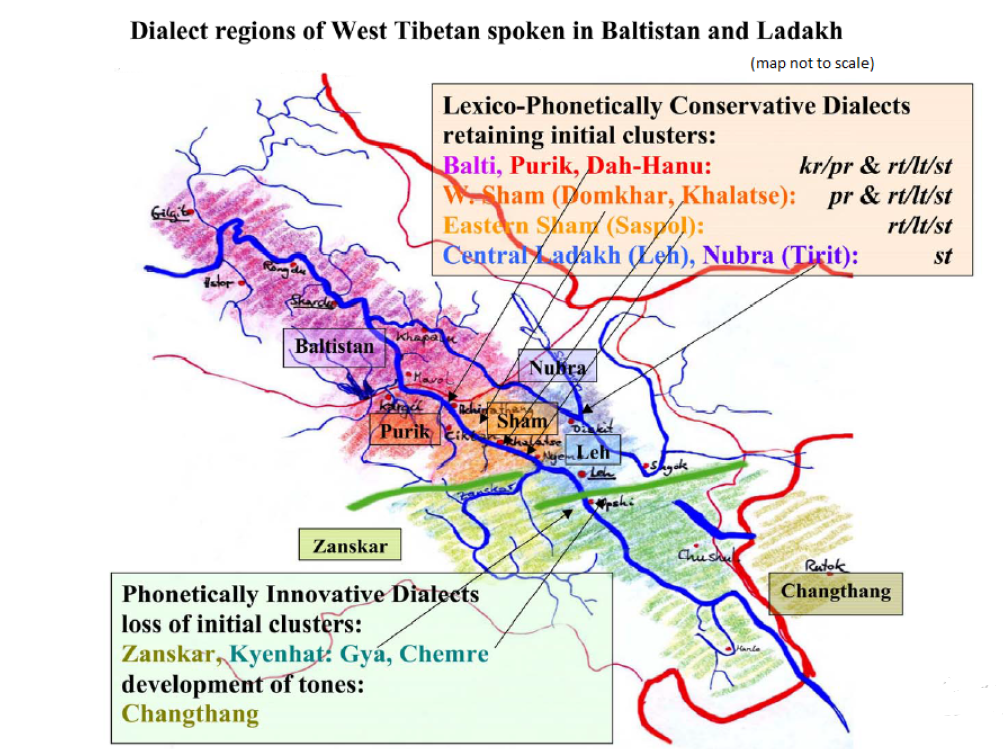
Map credit: Bettina Zeisler
Research context and data
My work on Ladakhi was conducted during my M.A. field methods training (2019) at the University of Delhi, where Ladakhi served as my primary language of analysis. Although this work was based on elicited data rather than in-situ fieldwork, it provided my first sustained engagement with Tibetic languages and laid the foundation for my later documentary research on Zangskari.
Data were collected over approximately 50 hours through regular elicitation sessions conducted in a classroom setting. Sessions were held primarily in English, with Hindi used where it facilitated more natural elicitation. Care was taken to elicit contextually appropriate utterances rather than word-for-word translations, and grammaticality judgments were incorporated in later stages of data collection.
Initial elicitation drew on a modified Swadesh list (Swadesh 1952), followed by phonemic analysis using targeted lexical items. Subsequent sessions focused on morphosyntactic domains, including nominal structure, negation, interrogation, valency-changing operations, and tense–aspect–mood systems. Particular attention was paid to pragmatic and evidential distinctions, which play a significant role in Ladakhi discourse.
Consultants
Two primary consultants contributed to this work.
The first consultant, Jigmet Dorje (aka Rigzin Gurmet), is from Basgo (Leh district). Due to early childhood residence in Ladakh followed by extensive education in Tibetan, his speech reflects notable influence from both colloquial and Classical Tibetan.
The second consultant, Nilza Angmo, has a multilingual and multidialectal background, with exposure to Purik, Zangskari, and Leh varieties of Ladakhi. Her linguistic experience proved especially valuable in identifying and explaining dialectal variation observed during elicitation. Her familiarity with Hindi and Ladakhi also facilitated comparative elicitation across registers and contexts.
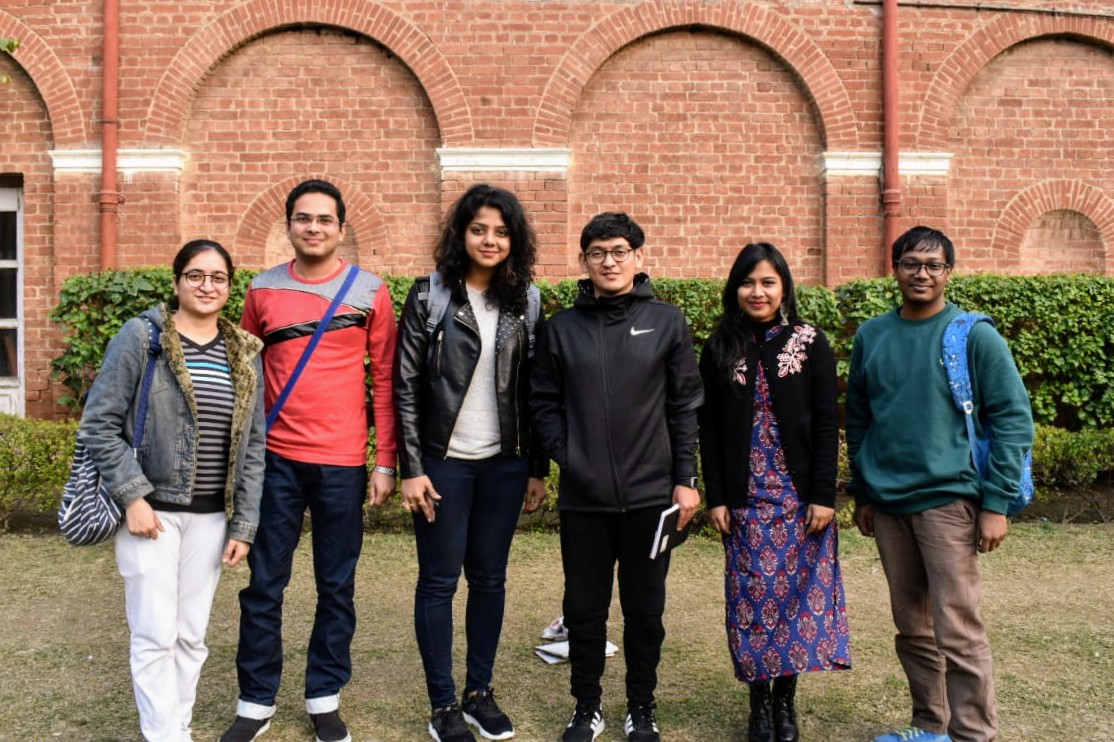
Consultant Jigmet Dorje during a discussion session.
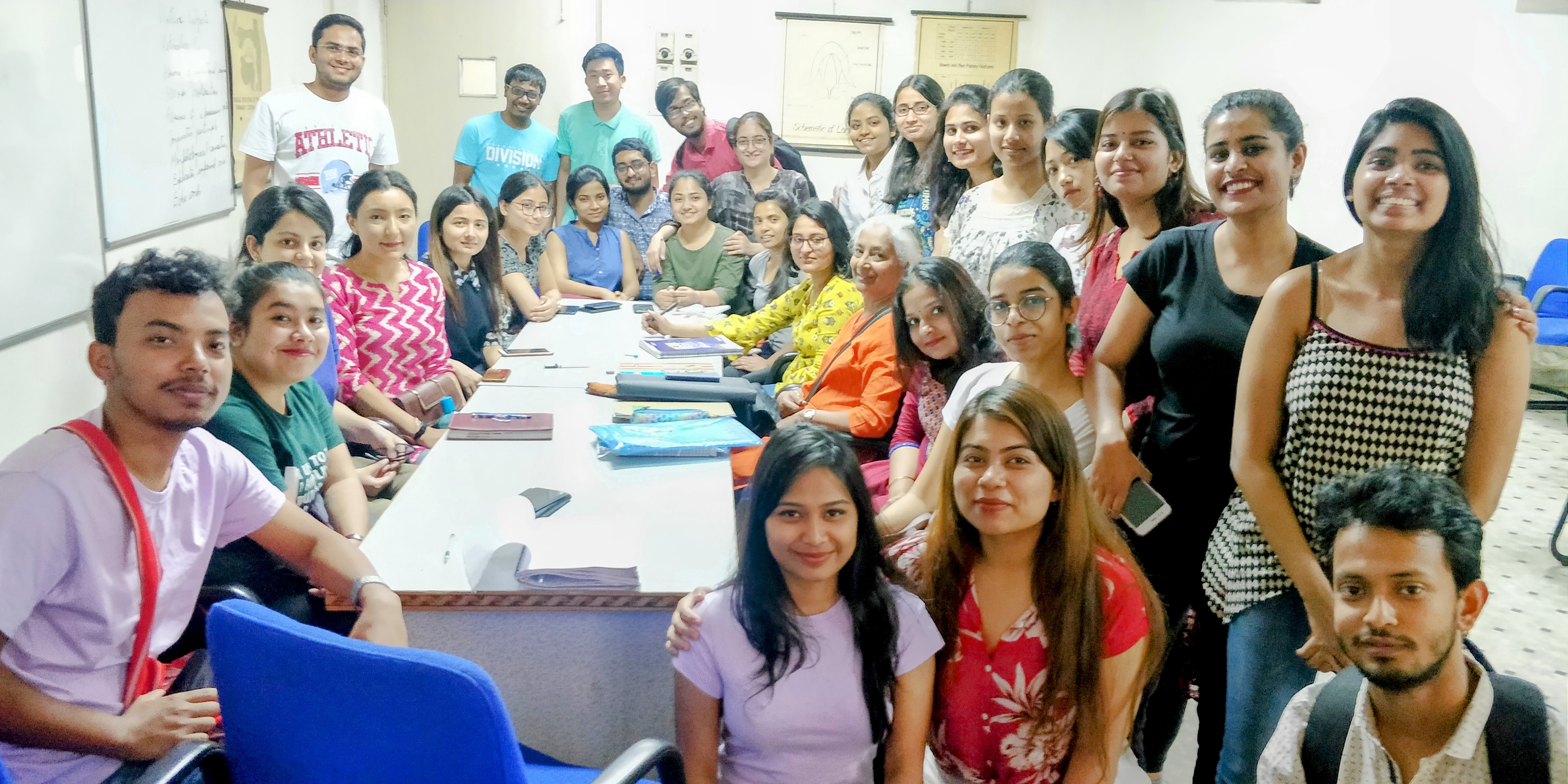
Field Methods cohort (2017–2019) with supervisor Dr. Gail Coelho after the final session with consultant Nilza Angmo.
Analytical focus and outcomes
My primary analytical focus during this project was interrogative constructions in Ladakhi, including yes–no questions, constituent questions, multiple wh-questions, and alternative questions. Declarative counterparts of interrogative structures were elicited to enable systematic comparison.
The analysis culminated in my M.A. thesis:
Interrogation in Ladakhi
University of Delhi (2019)
This work provided a descriptive account of interrogative strategies in Ladakhi and introduced me to key issues in Tibetic morphosyntax, pragmatics, and elicitation methodology. More broadly, it served as a methodological and analytical precursor to my later corpus-based documentary work on Zangskari.